

Mother Means More
A Reflection on Maximalist Maternal Mediation in the Bible’s War for the World (During Advent, the Final Month of Mary’s Pregnancy)

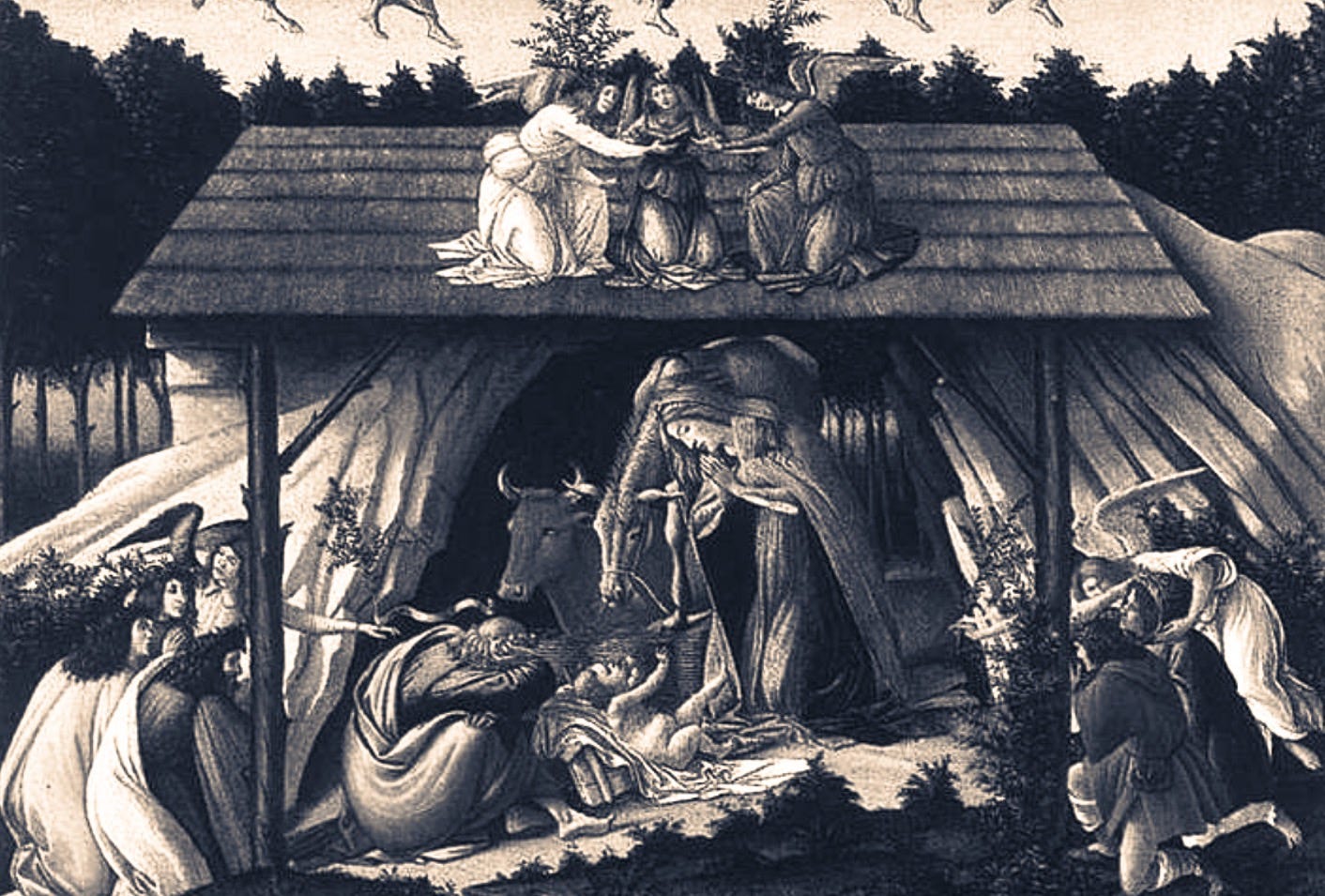
“War is the father of all things.”
This saying of the ancient philosopher Heraclitus applies in a special way to knowledge: only when our preconceived notions are forced into a war with apparent or real contradictions do we learn. And reality is the ultimate contradiction to comfortable, acceptable notions. This is part of the reason tradesmen have a harder time being bamboozled by sophistical arguments—because they are the first to find out when reality bites back.
To begin, then, with a contradiction: They say that behind every good man there is a good woman, and this is usually taken to mean the man’s wife.
The truth is that behind every good man, by which I mean a Christian man, there are at least two good women, neither of whom is the man’s wife.
Yes, there is the wife too, but as God showed with Adam in the Garden, she comes later.
So, who are the previous two women behind every Christian man?
In simplest terms: there is mother 1, your mother in the order of nature, and Mother 2 your Mother in the order of grace. Of the two, the second is perhaps less thought about, so that lady first.
Mother Two is Mother Too
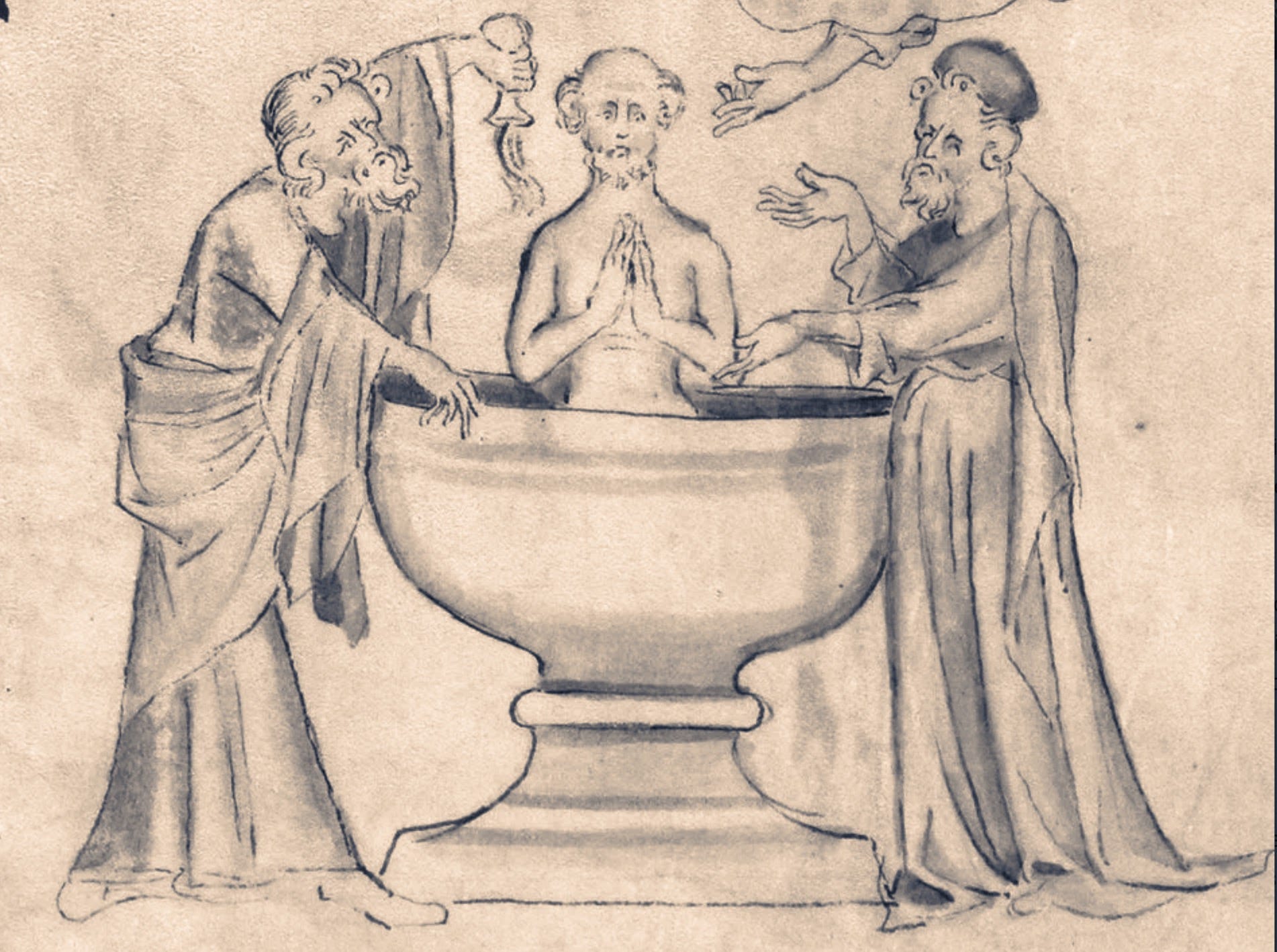
Every Christian is, by definition, “born again” at the baptismal font, a font which many in the early and later Church referred to as “the womb of holy mother Church.” In using this language, the early church was simply drawing out the implications of biblical patterns of presentation in which women, and their maternal power, show up in physical and symbolic connection with wells, springs, streams, and rivers of water.
In the semi-arid land God chose for the staging of the Bible “water = life” is not an equation requiring much explanation.
Starting at the end of the Bible, there is “the Bride, the wife of the Lamb” (Rev 21:2-9) who is depicted as a city with a stream flowing down the middle of her streets (Rev 22:1-2)[1].
Or, think of Jesus talking with the woman of Samaria, about marriage, at a well (John 4).
Or, think of Nicodemus asking Jesus about the possibility of going back into his mother’s womb and Jesus responding that he must be born again “of water and the Spirit” (John 3:4-5).
Or, think of young Tobiah who wrangles in a river with a water-monster as the prelude to having to wrangle with the demon afflicting his future wife (Tobit 6).
Or, think of Moses who won his future wife by some heroics at a well (Exo 2:16-21).
Or think of Jacob’s wife and the well (Genesis 29)
Or think of Isaac’s wife and the well (Genesis 24).
And, well, you get the picture.
Lots of biblical men meet their wives at wells.
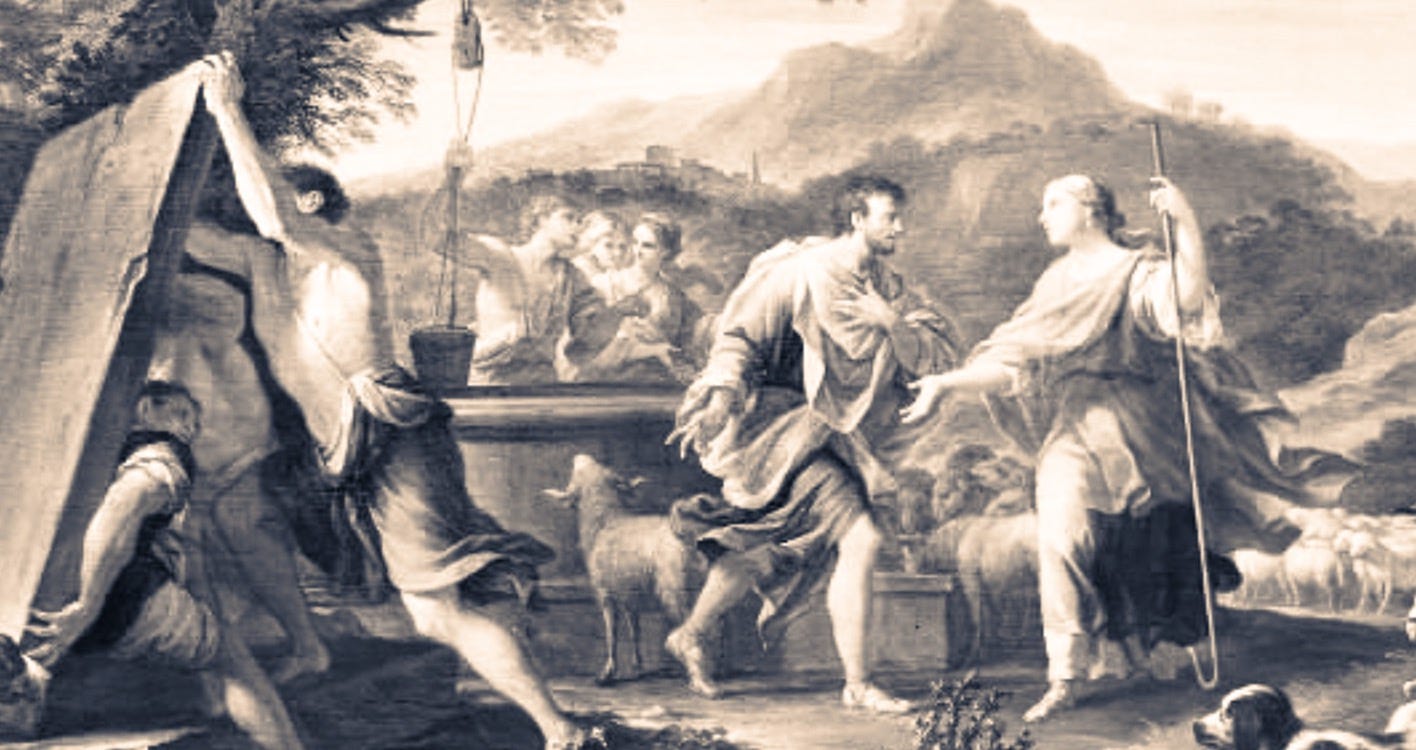
But the marrying of a woman, in the Bible, is always bound up, as it is in nature, with her becoming mother.
These later biblical events and visions of wife-at-the-well are all rooted in the story of what happened just before the first time a man met a woman, ever. Genesis 2 begins with a spring of water, flowing up to water the face of the dirt (Hebrew adamah) from which God then makes the man (Hebrew Adam).
St. Ireneus, in the very early church, is certainly within his biblical rights to see here, not a marital image (yet), but first a maternal one. He connects the virgin earth and her maternity of the first Adam with the virgin Mary and her maternity of the new Adam, Jesus Christ.
Whence then is the substance of the first-formed (man)? From the Will and the Wisdom of God, and from the virgin earth. For God had not sent rain, the Scripture says, upon the earth, before man was made; and there was no man to work the earth. From this, then, whilst it was still virgin, God took dust of the earth and formed the man, the beginning of mankind. So then the Lord, summing up afresh this man, took the same dispensation of entry into flesh, being born from the Virgin [Mary] by the Will and the Wisdom of God; that He also should show forth the likeness of Adam’s entry into flesh, and there should be that which was written in the beginning, man after the image and likeness of God.[2]
So, every Christian Man has a Mother as Adam (dirt man) did. The Christian man is a regenerated complex of dust (his fallen human dirt) and baptismal water, over which hovers the Holy Spirit (Gen 1:1). A Christian man comes to life like Moses did—the result of a conspiracy between two mothers against the decree of universal death. He must be “drawn out” of the water as out of well, or a woman (Exod 2:10). He is, thereby, “born again.”
Mother One is Mother Won
Here I hate to sound pedantic, but sometimes the plain old truth is the most important: before a man can be born again, he must be born. And there is a mother for that as well, and she is, in terms of life and sense-experience, absolutely primary. And, as God’s making of Adam from mud makes clear—He did not have to do things this way, but He did.
Karl Stern, a Jewish-Catholic psychologist (think “Freud minus the weird stuff”) points out in his book Flight from Woman, that every human person’s absolutely first experience, willy-nilly, is: mother. To highlight the importance of this fact for the foundations of our psychology, he notes also that as we get older, time is generally experienced as going faster. The psychological-temporal “space” between one year and the next when you are forty-nine seems to be about one-fortieth of what it was when you were nine. So, he argues, if we reverse that process and insight, this means that our experience of time gets slower and more expansive as we get back closer to our moment of origin.
Taken to its limit this means that each of us experienced, in utero, a quasi-eternal mental and physical fusion with our mother. Aside from deriving our being from hers, and having our being protected by her being, however, there was, at the end of the nine-month-temporal-eternity, the experience of the other meaning of Mother: she pushed us out. Time to show you off to the world, and most importantly, time to go meet your father.
And this is one of those natural symbols that is simultaneously so personally innermost and universally outermost that we might miss it.
And so, the Bible reveals it, where else, in the book of Revelation. The earth surrounded by the cosmic symbols of the sun, the moon, and the stars is only adequately revealed as “a great sign—a Woman . . . laboring to give birth” (Rev 12:1-2).
St. Paul apparently saw something similar when he wrote to the Church of Rome: “For the creation waits in eager expectation for the sons of God to be revealed . . . We know that the whole creation has been groaning as in the pains of childbirth right up to the present time” (Rom 8:19-22).
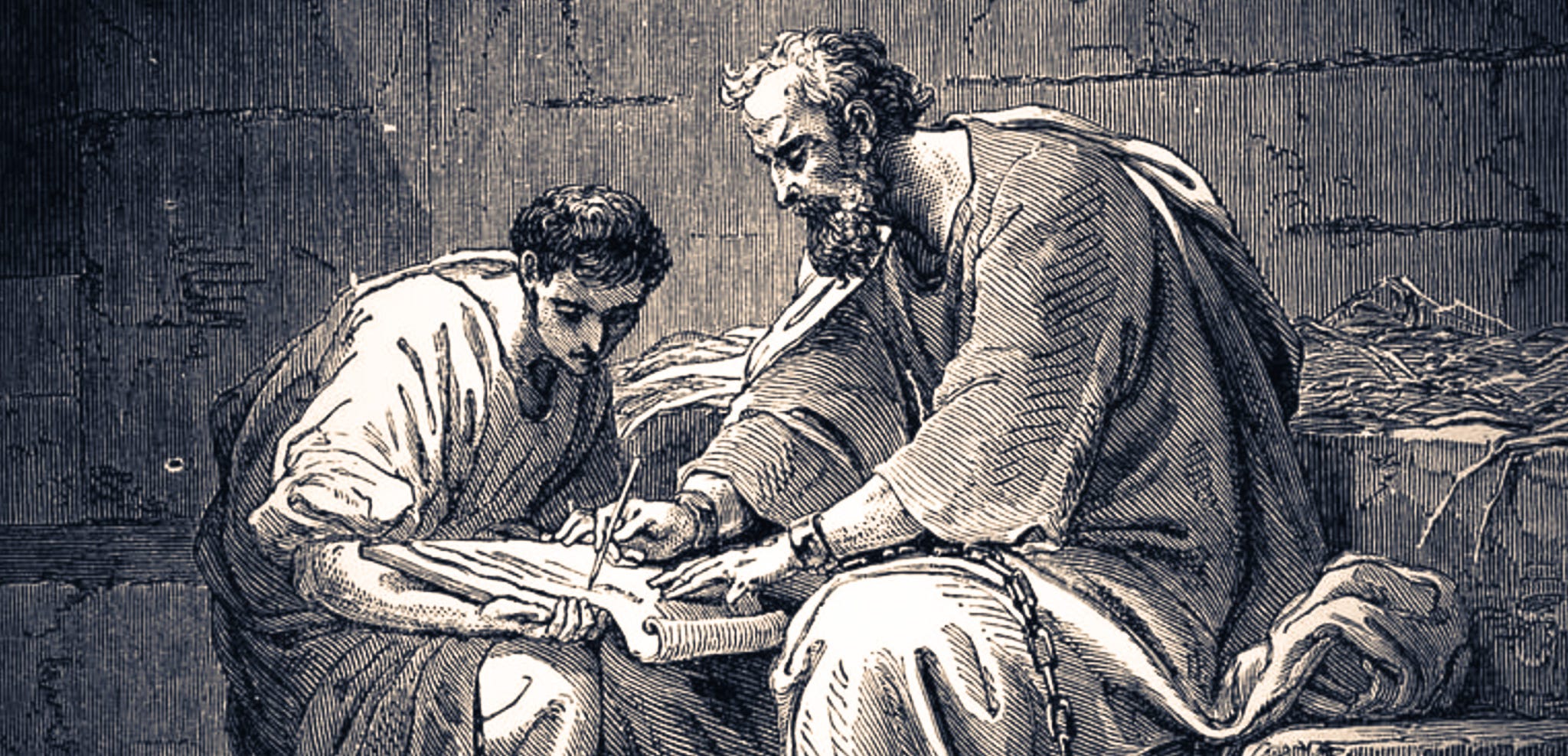
And the Church of Rome, in particular, has certainly picked up on this reality and elaborated it since the time of St. Paul.[3] The recent kerfuffle from Rome[4] about two terms in particular—co-redemptrix and mediatrix—are as good a reason as any this Advent to reflect on two other terms—biblical ones—which mean more.
The trick with the “trix” ending to these Latin words is simply that they mean “female version of” redeemer and mediator. One other revealing example comes from the Latin translation of the earliest Marian hymn outside the Bible—the Sub Tuum Praesidium[5]—which names Mary “sancta Dei genitrix” that is, holy-feminine-generator-of God.
As upside down as that sounds, the Bible had already said it. When God first ponders making a woman, He says to Himself that He will make for the man “a helper-fit-for-him” (ezer conegdo).
The plain implications for the rest of salvation history are present right there. Whatever Adam does, she is going to help. Likewise with the New Adam.
Is the New Adam the creator? Yes. Then mysteriously she helps (see Prov 8:22-31; Sirach 24).
Is the New Adam the redeemer? Then she helps (see John 19:25-27).
Does the New Adam sanctify? Then she is going to help (Luke 1:35; Acts 1:14-2:4).
Irenaeus is helpful here as well:
“And thus also it was that the knot of Eve’s disobedience was loosed by the obedience of Mary. For what the virgin Eve had bound fast through unbelief, this did the virgin Mary set free through Faith.”
Something more that is hidden in the Hebrew text of Gen. 2:22 is that the essence of her womanhood and helper-hood is quite literally built-in to her being from the beginning.
When God made the Man, He “pottered” (vayyitzer) him out of clay. But when He made the woman, the text uses a different verb—vayyiben—literally “built.”[6] Even more literally, however, the last part of this word, “ben”, is the word for “son.” Motherhood, though only implied at this point, is built in to Womanhood.
Paternity is where everything begins in eternity (John 1:18), but Maternity, in the divine plan revealed to the Angels from before the beginning (Revelation 12), is what will build-up Mankind in the mater-ial world and in time until the end of time.
And the woman’s other name makes this explicit: She is “Eve” which mimics Hebrew “Havah” which the Septuagint translators rendered in Greek as “Zoe” meaning “Life” because, as the text says, “she became mother of all [the] living.”
So, there you have it. If there is going to be life in this fallen world, it is only going to be, by God’s design and Adam’s declaration, in and through Eve, mother of all the living.
And this has consequences: As time goes toward its end, there is an ever-increasingly maximalist intermediation of being. You exist only because of a bigger and larger and ever-more complex history of real mothers behind you.
And Providence is poetry; history means. As time goes on, maternal mediation maximalizes. If God designed Mother as our first individual experience, it may be that He also designed for us a community to reach the same insight.
If what St. John saw in Heaven at the end of the Bible is anything to go by, this war about the Mother is the real war that Fathers all things (Rev 12:7).
But the Lord had already said it at the other end of the Bible too when He said to the serpent:
I put enmity between thee and the Woman between your seed and her seed. She[7] will crush your head. (Gen 3:15)
This warfare is specifically about the meaning of maternity. If we return to that “trix” feminine ending, here is a Marian title and picture worth a thousand words: Exterminatrix of Heresies.
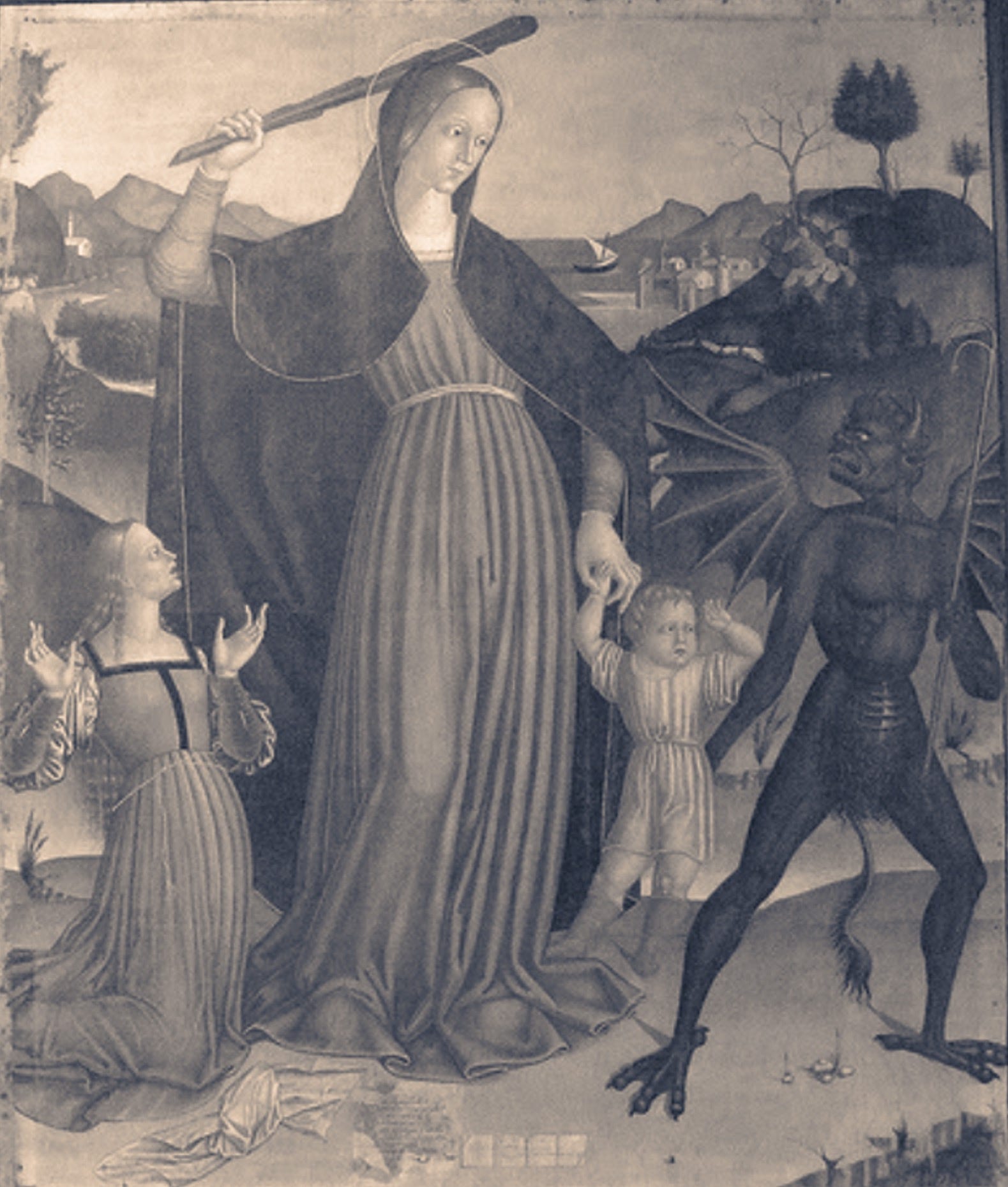
This is in some ways much better than a cozy Christmas scene, because it reveals the reality of Maternity—it is war—and Mother won.
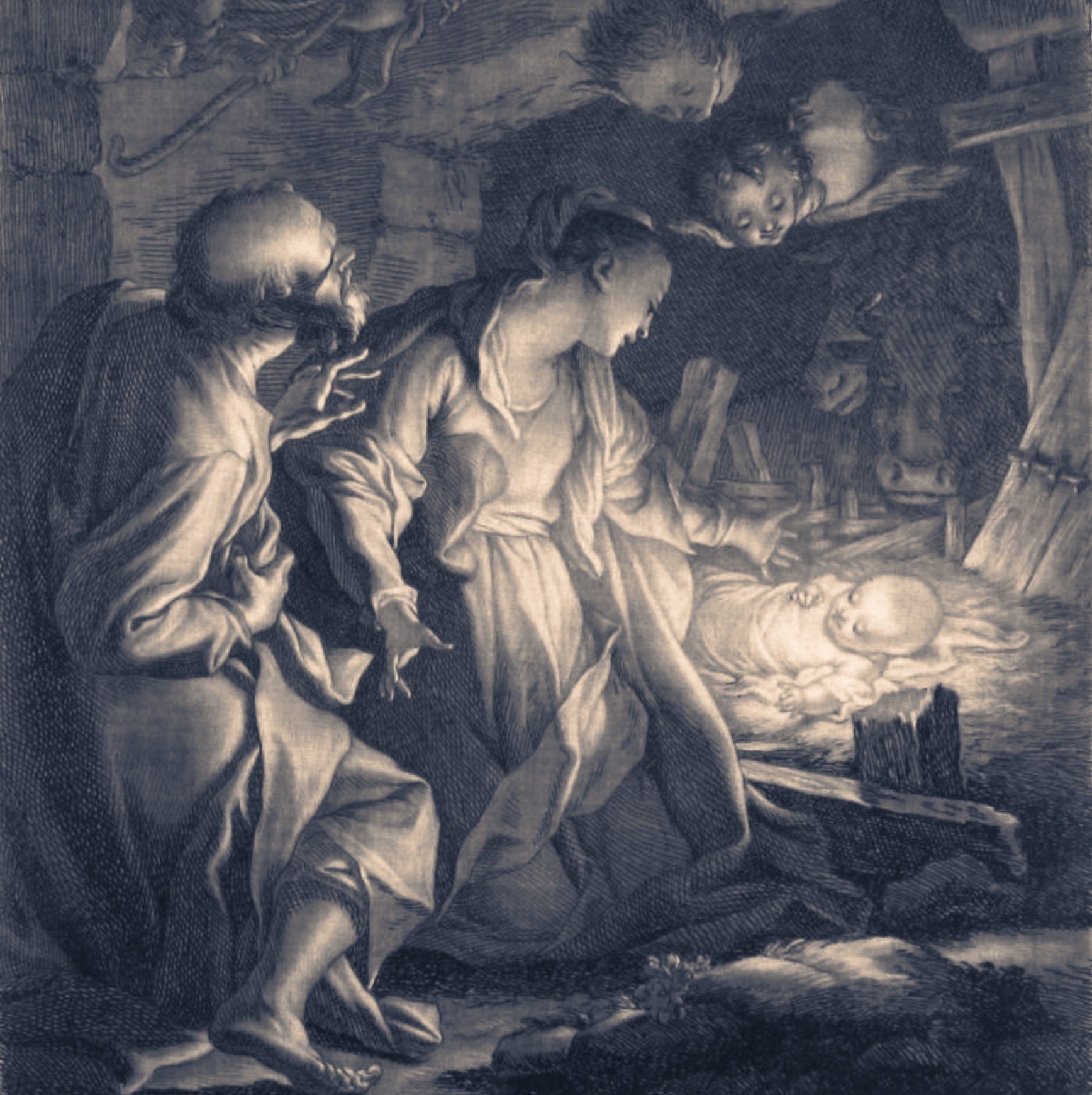
At Christmastime we can get a kind of cozy fluffy nostalgia about the scene at Bethlehem and we can forget what the Apocalypse reveals about the spiritual realities of in the uncharted waters of the Incarnation—“here there be dragons.” St. Luke too tries to tell us that there appeared to the shepherds a stratias (“an army”) of Angels praising God (Luke 2:13).
In the Bible, praise of God happens when a war has been won. The birth of Christ was a battle the dragon lost, and the Mother won.
John tries to show us the dragon the Angels were there to combat, and the Lady they were there to protect. But both Luke and John are showing the same reality. There is a war going on. And Christians ever since have been saying that Heraclitus only had it half-right when he said that war is the father of all things.
A saying more in keeping with reality deeper than “war is the father of all things” is this:
Mother is the war of all things.
So, enjoy a Merry-Christmas, yes.
But far more important is that Christians come to enjoy what God chose to enjoy when He took to Himself a created human nature in his Mother’s womb—a Mary-Christmas.
[1] See 2 Sam 20:19 for the biblical equation city = mother. See Gal 4:26 for the more specific equation Jerusalem = Mother.
[2] Irenaeus (d. ca. 202 AD) was a disciple of St. Polycarp who was a disciple of John the Apostle. From his work Demonstration of the Apostolic Preaching, 32.
[3] Fr. Thomas Crean, OP: “Mary as a New Eve in the Thought of St Paul” New Blackfriars Volume 103, Issue 1107 (2022) pp. 662-677.
[5] the oldest prayer to the Blessed Virgin Mary _ Sub tuum præsidium | Liturgia
[6] This is clear from its frequent use elsewhere in Genesis to describe the building of two important structures: cities and altars (Gen 4:17; 8:20 and many others). In Gen 16:2; 30:3, however, it is used specifically of a woman who hopes to be “built up” or to build up her husband’s house[hold], through the birth of a son. The Greek Old Testament of Gen 2:22 used the word okodomesen (ᾠκοδόμησεν), literally “house building.” The derivatives of this word appear most frequently in the NT in the letters of St. Paul for talking about the “building up” of the Church, but its most iconic appearance is in Matt 16:18 where Jesus says, “You are Peter, and on this rock I will build (oikodomeso, οἰκοδομήσω) my church” which is the foundation in history for St. Paul’s later feminine imagery of the Church as the bride of Christ.
[7] For a defense of “she” as distinct from “he” “it” or “they” referring to the seed of the woman, or the woman and her seed, see: AquinasReview-Vol25.pdf